
Over the years, White Light (WL) has shown a continued commitment to being a sustainable organisation. Now a certified B-Corp, the company has built a reputation for helping customers transform their existing lighting systems into something more environmentally-friendly (a topic WL led a seminar on at this year’s PLASA Focus Leeds). The latest venue to make this move from tungsten to LED is Regent’s Park Open Air Theatre. To offer an insight into how a transition like this comes about, the various steps involved, along with the impact it has on a venue, we’ve asked Regent’s Park’s Head of Lighting Joe Kirk to put together a blog which looks precisely at this.
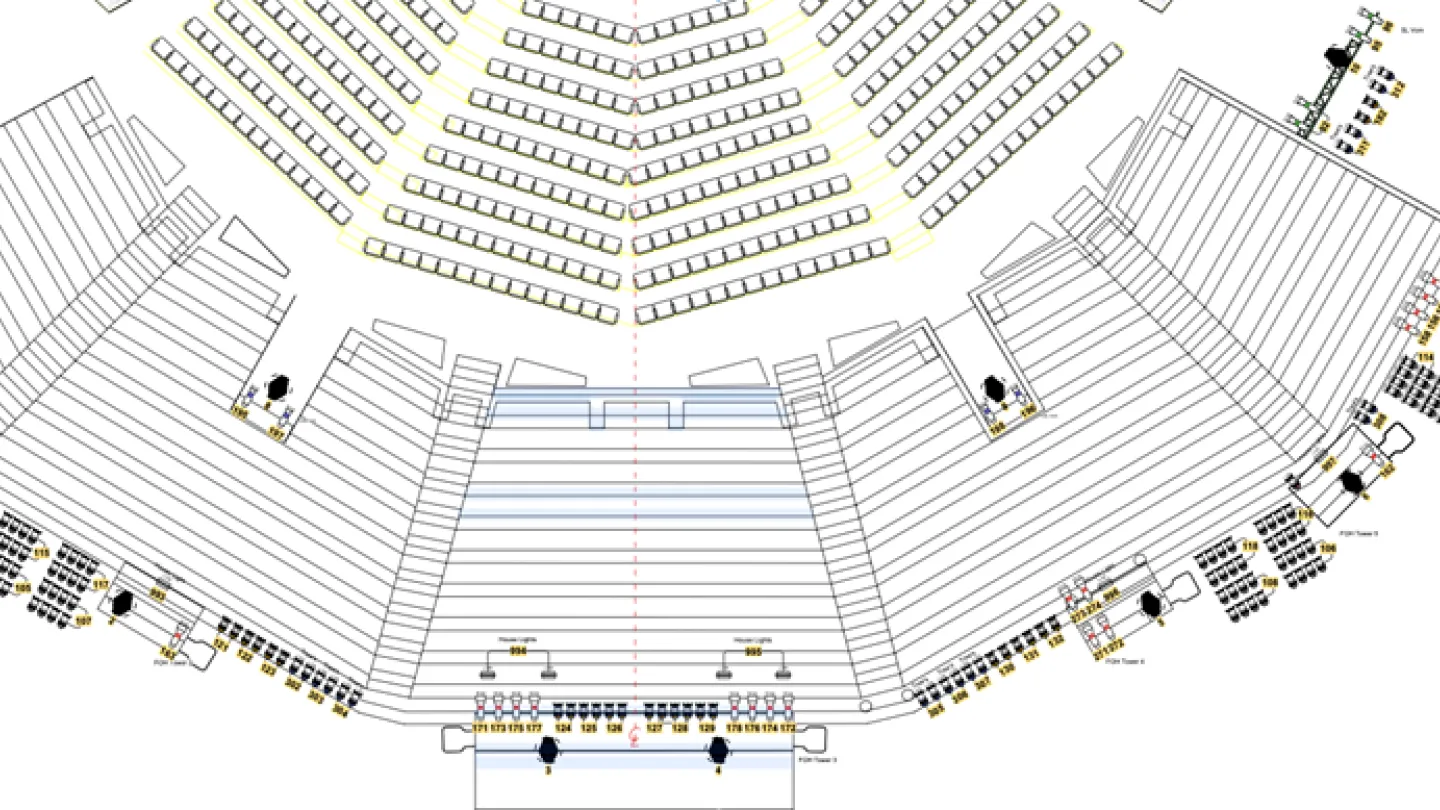
Situated in the beautiful surroundings of a Royal Park, Regent’s Park Open Air Theatre has both nature and the environment at its core. One of the company’s goals is to be as environmentally friendly and sustainable as possible; which ultimately led to a review of the lighting setup across this current season. As with most venues, the previous lighting set-up prior to this upgrade was one that had evolved over a number of years. When I started back in 2016, it was a largely tungsten rig with 128 x ACL par cans providing FOH (front-of-house) cover. These were made into eight banks of eight fixtures, giving lighting designers a multiple colour front light – which sadly took a very long time to focus! The rest of the rig consisted of generic Source Fours and Par Cans. The moving light fixtures were a mixture of MAC III Profiles and VL3500s mounted inside wooden moving light covers painted green to disguise them into the foliage behind!
There were many practical issues with this rig. The colour call on the ACLs cost a small fortune and the lamps could be unreliable – to the point where if one blew then all eight would need changing. The generics weren’t IP-rated either so on a rainy day, the Chief LX would have a hard time keeping the AVO dimmer racks from tripping out. The moving lights needed constant maintenance and cleaning to keep them pollen free. The wooden boxes meant that on a warm day the fixtures would lamp off as they were overheating. Our rigging positions are 10M tall vertical truss towers so swapping out at 45kg moving light from the top of these whilst not re-focusing the lighting rig below was a challenge undertaken far too often!
There were also design limitations with the rig. Due to the throw distances from the FOH truss towers to the stage, the Source Fours and Par Cans were all paired together to get maximum light output onto a stage that would still be lit by the sun at 9pm on a summer’s afternoon. This meant designers could only really have a two-colour wash. On our Pros position, the lack of colour changing fixtures meant that on a large musical, the LD had to use the few moving lights we had to their maximum potential on every single cue.

The rig was primarily like this due to affordability and the available technology at the time. Until recently, the waterproof moving lights available such as the SGM G-Spot weren’t traditionally designed for theatre. Equally, there wasn’t a waterproof LED Ellipsoidal that was suitable for our needs. We found that most intelligent fixtures could be waterproofed for use outdoors using various wooden hides and lids but when it came to hiding these fixtures away in set pieces, the waterproofing was often the reason they got cut as it was so unattractive and bulky. Last year marked my first as Head of Lighting and I realised straight away that I wanted to make some big changes to the rig. The main goal, in line with the theatre’s wider aims, was to upgrade to LED; due to how power intensive and expensive our rig had become to use. Another reason was to offer our designers as many creative options as possible.

That said, I realised everything we were currently using was part of WL’s pre-existing stock – whereas everything that I wanted was going to have to be invested in. I’ve always known WL to be a company that is approachable and tries it’s hardest to offer clients the very best service. As such, I had a chat with Stuart Porter and Dominic Yates about how I wanted to redesig the rig and make it more modern. Crudely put, I knew we couldn’t afford to specify a brand-new lighting rig that WL would have to then go out and buy in for us so it would have to come out of their existing lighting stock. The team listened to what I had to say and believed we could come to some sort of arrangement – one which fulfilled my artistic and practical needs but also my budgetary ones. It was perhaps my good fortune then that the Christmas Trails had just finished – a project in which WL had invested heavily in IP-rated fixtures – and that these units would now be available for the summer…
In order to understand what fixtures we actually needed, I broke down the season rig into its various elements. At FOH, we have a throw distance of around 40m from rigging position to the stage. Any moving light rigged here has to have a very narrow beam angle in order to be useable and any ellipsoidal has to be bright. We’ve found these fixtures are very useful in this position so can’t be moved by the LDs on turnarounds. These positions are also under cover so the fixtures don’t have to be waterproof. Knowing this, we visited WL’s Wimbledon base and had a shootout between the Ayrton Eurus and the Halcyon Titanium; both fixtures we know would work well in this location. Due to availability, we drew on the Halcyon.

Shoot out of Ayrton Eurus + ETC Halcyon + Ayrton Perseo at White Light in March
On our vertical truss towers, we needed a moving light that was waterproof, reliable and bright. It was important that the fixture worked in the early evening so we had to demo this in a bright environment. After a series of shootouts at Regent’s Park, we found the Ayrton Perseo to be the perfect fit in this position.

The old season rig consisted of, amongst other things, 120 x Par64s, which made up a combination of key lights for the stage as well as accent lighting to illuminate the site and surrounding trees. For the key light, they were used to get brightness onto the stage during twilight hours and during matinee performances. After lots of shootouts, we chose the VL800 RGBA to replace these. They have the intensity and colour required and are waterproof but, vitally, can take theatrical accessories such as top hats. We’ve also been able to take advantage of new technology with the new Mac Aura XIP which enables us to have moving lights in discreet locations without the need for waterproofing. Zoe Spurr, the lighting designer on Robin Hood: The Legend, actually used four of these on the forestage as footlights.
Around the venue, we used to have 70 x Par 64s as accent lights that created atmosphere and depth on the surrounding trees. Swapping these to an LED alternative was an easy decision. As a large quantity of units was required, the Chauvet H12IP was chosen as it met both our practical needs and budget.

Needless to say, the move to LED has been an extremely positive one. The lighting designs on our first two shows Once On This Island (light by Jessica Hung Han Yun) and Robin Hood: The Legend (light by Zoe Spurr) would simply not have been possible with the old rig. From an environmental point of view, the old season rig had a potential power draw of 225KW compared to the new LED rig’s 59KW; meaning both energy consumption and running costs have been completely slashed.
This important change was only made possible with the help of WL. We were aware of how they’d assisted several other venues in making this leap to LED and they were incredibly helpful once again in our case; listening to our needs, our budget and our limitations to create a package that managed to fulfilled our requirements. We are incredibly proud of the lighting rig we now have at Regent’s Park Open Air Theatre and look forward to welcoming audiences across the rest of the season.
The post White Light Oversees Regent’s Park Move to LED Lighting Rig appeared first on White Light.